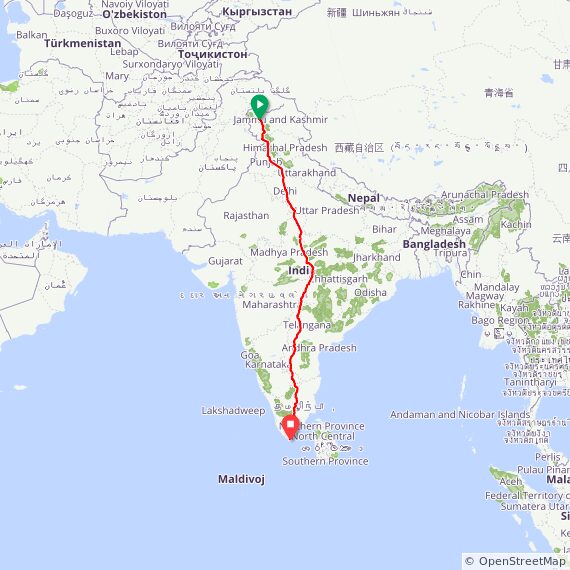
A confidence-rebooting boomerang of a ride — snow-covered mountains to sun-soaked beaches, edge to edge down the length of India.
What do you call a confidence-rebooting event in your life? I call it the Boomerang — and the Kashmir-to-Kanyakumari Expedition was exactly that for me and my team. It was a challenge I had been looking forward to for years. These were tiring times after my collar-bone fracture, and I had to push myself hard under a strict training regime; we had studied and planned the event down to the smallest detail.
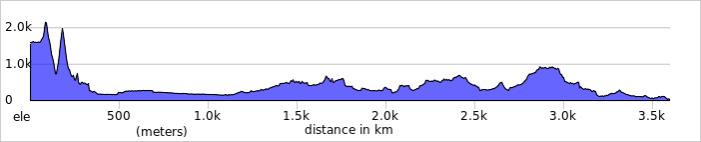
On the philosophical side it was mesmerising — snow-covered mountains, rivers running through valleys, and the sun-soaked beaches of Kanyakumari. The route was about 50% flat, 30% rolling and 20% mountainous.
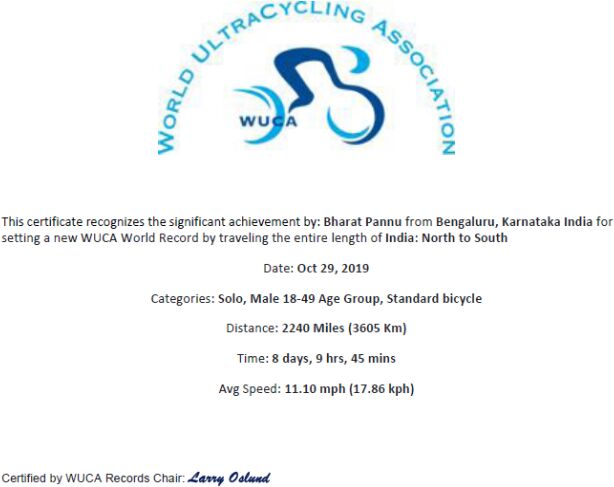
Start: 0149 hrs, 21 October 2019. Total expedition time was 201 h 45 m, of which my riding time was 156 h 10 m. Off-saddle time across eight days totalled 45 h 30 m — physiotherapy, bath, nature's call and sleep.
The machine. I rode a Scott Foil 20, whose aero geometry and positive-angled stem suited my long pulls with comfort and good cruising speed. A single Physiosaddle (Edge Cycling Technologies) saw me through the whole ride with no chafing, and I had no mechanical breakdowns except two punctures.
Day 1 — Srinagar to Jalandhar (455 km). We started at 0149 hrs to own the mountainous terrain in negligible traffic. The valley was breathtakingly dangerous in the dark at 2°C. We crossed the Banihal Tunnel at 5 am, were turned away from the Chenani-Nashri Tunnel in daytime traffic, and detoured via Patni Top (+26 km, +1,500 m). Road construction near Ramban coated rider and bike in dust, forcing repeated cleaning and drivetrain lubrication.
Day 2 — Jalandhar to Mathura (504 km). Off the mountains and onto smoother plains with pleasant weather. We cut through the heart of New Delhi at 1800 hrs to save about 50 km versus the peripheral highway.
Day 3 — Mathura to Lalitpur (423 km). Bad roads between Dholpur and Gwalior, plus construction between Gwalior and Jhansi, forced lower speeds and frequent drivetrain care.
Day 4 — Malthone to Pench Tiger Reserve (398 km). Good roads returned, but near Pench on NH-44 it rained over 16 never-ending kilometres of construction — Cyclone Kyarr had hit the western coast.
Day 5 — Pench to Armoor (418 km). Rain poured all the way to Nagpur; we still managed a good pace.
Day 6 — Armoor to Kurnool (385 km). Strong headwinds blocked our pace and night riding was severely hampered by heavy rain, though we crossed Hyderabad on smooth roads around 1100 hrs.
Day 7 — Kurnool to Bangalore (339 km). Flooded roads and near-zero visibility on the city outskirts made it hard to even follow the white line. We bypassed the city on village roads worn out by a month of rain.
Day 8 — Bangalore to Virudhunagar (508 km). Clear skies and soothing weather lifted both our mental and physical posture — and our mileage.
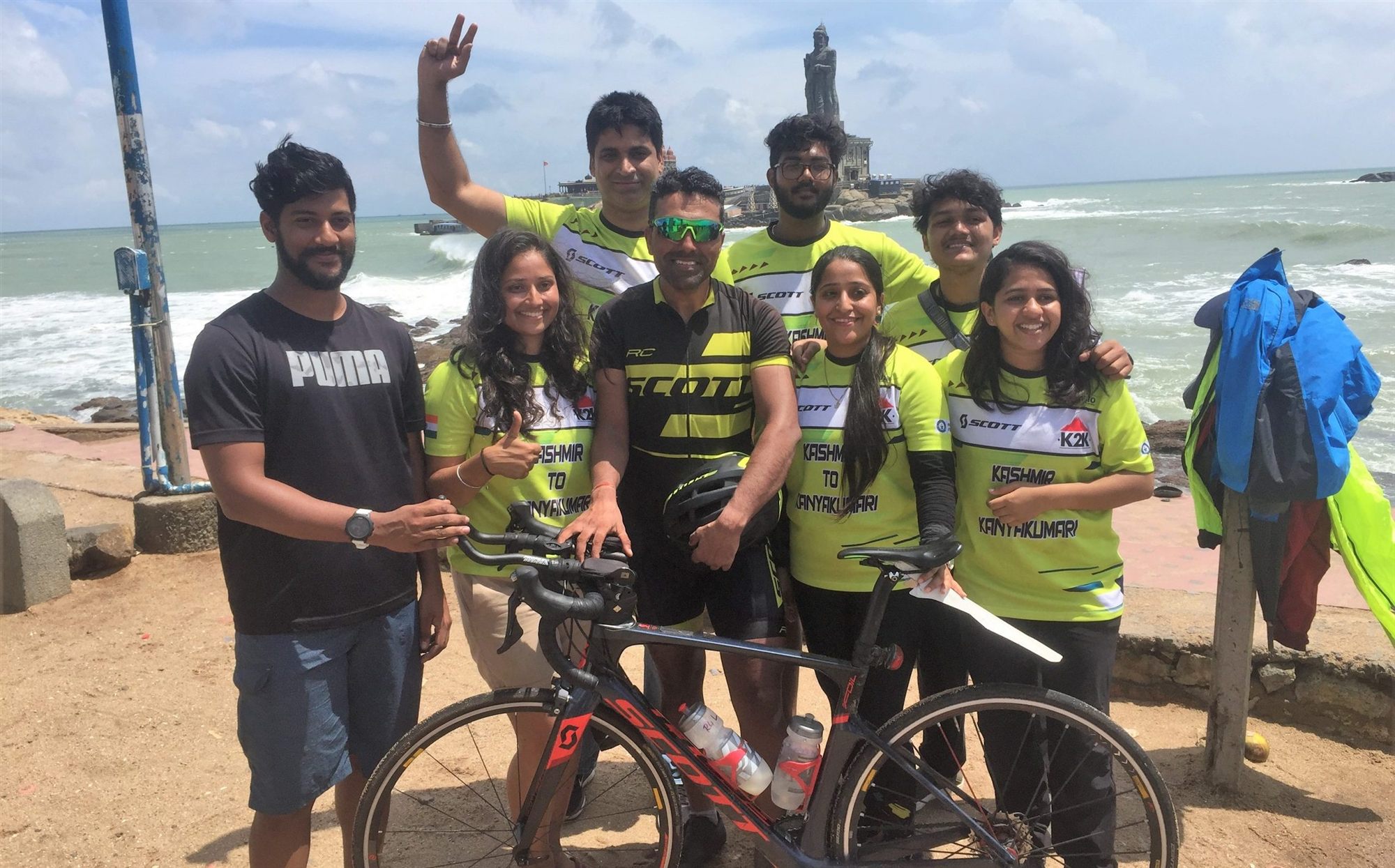
Day 9 — Virudhunagar to Kanyakumari (185 km). Words are no match for the spirit we carried that day. With a bit of tailwind from nature, we paced as fast as possible — not just to finish, but to finish in record time. End: 1134 hrs, 29 October 2019.
Giving back. We followed a zero-waste policy and ran the 'Go Green' campaign throughout, having planted 5,000 trees in Wasali Shivar, Nashik in August 2019 with the Forest Department and Samsonite. The Guinness recognition was the cherry on the cake — but the most cherished part is the memories that will stay with us for a lifetime. Records, after all, are made to be broken.
The numbers. The 3,604 km route was roughly 70% flat, 20% rolling and 10% mountainous, with a cumulative elevation gain of about 20,447 m. Total expedition time was 201 hours 45 minutes, of which riding time was 156 hours 10 minutes. Coming back into shape within five months of his California collarbone fracture and then breaking the existing record by almost two days made this, for Bharat, a genuine confidence-restoring ride. The record is listed by the World Ultra Cycling Association.