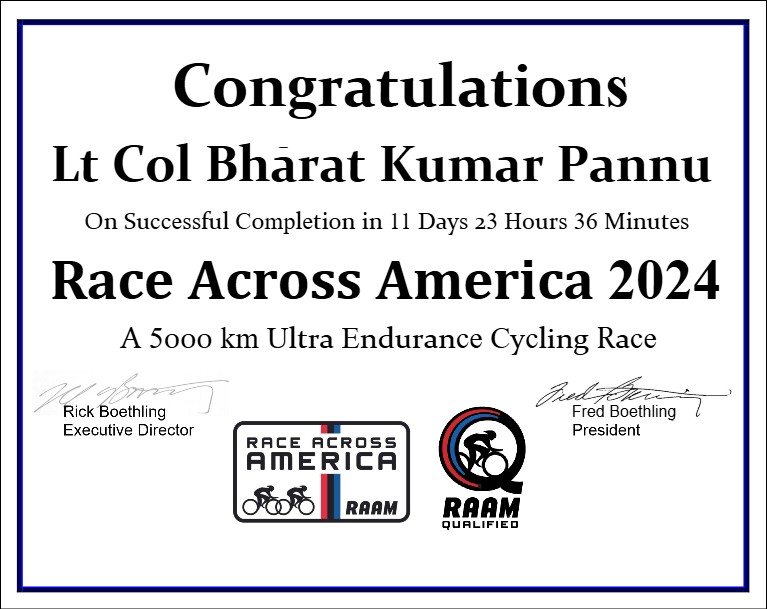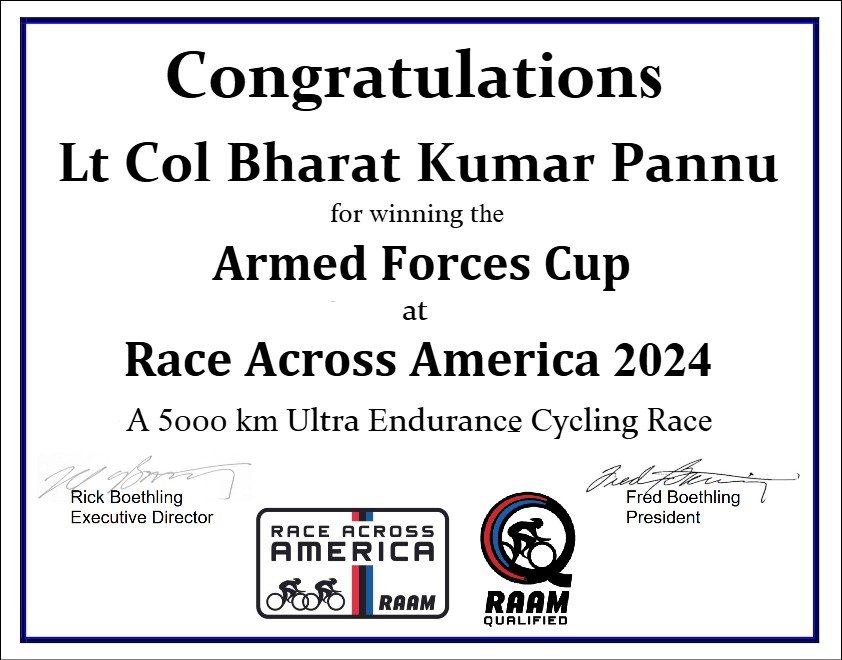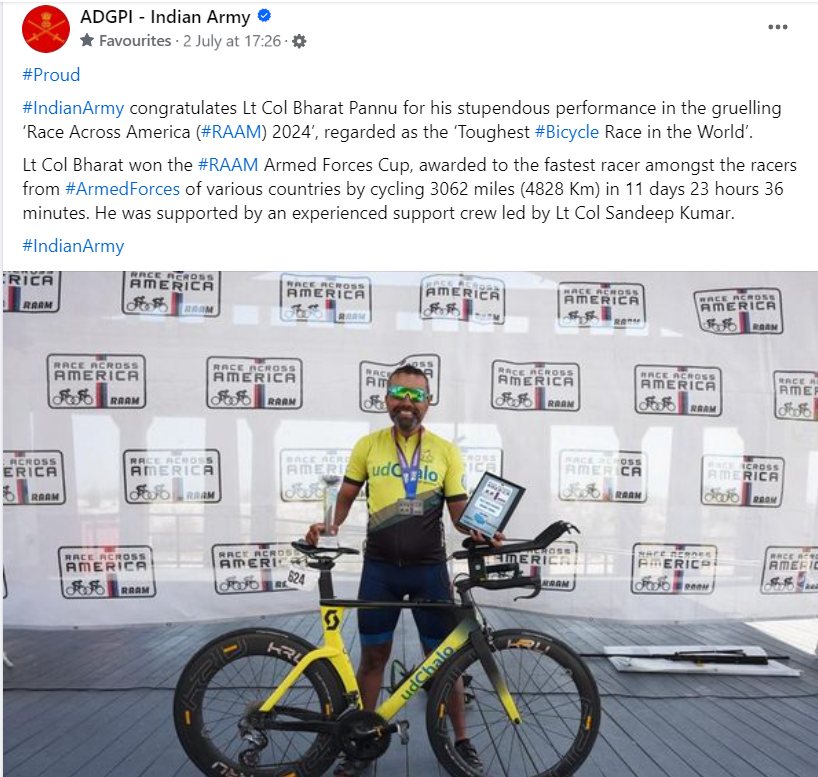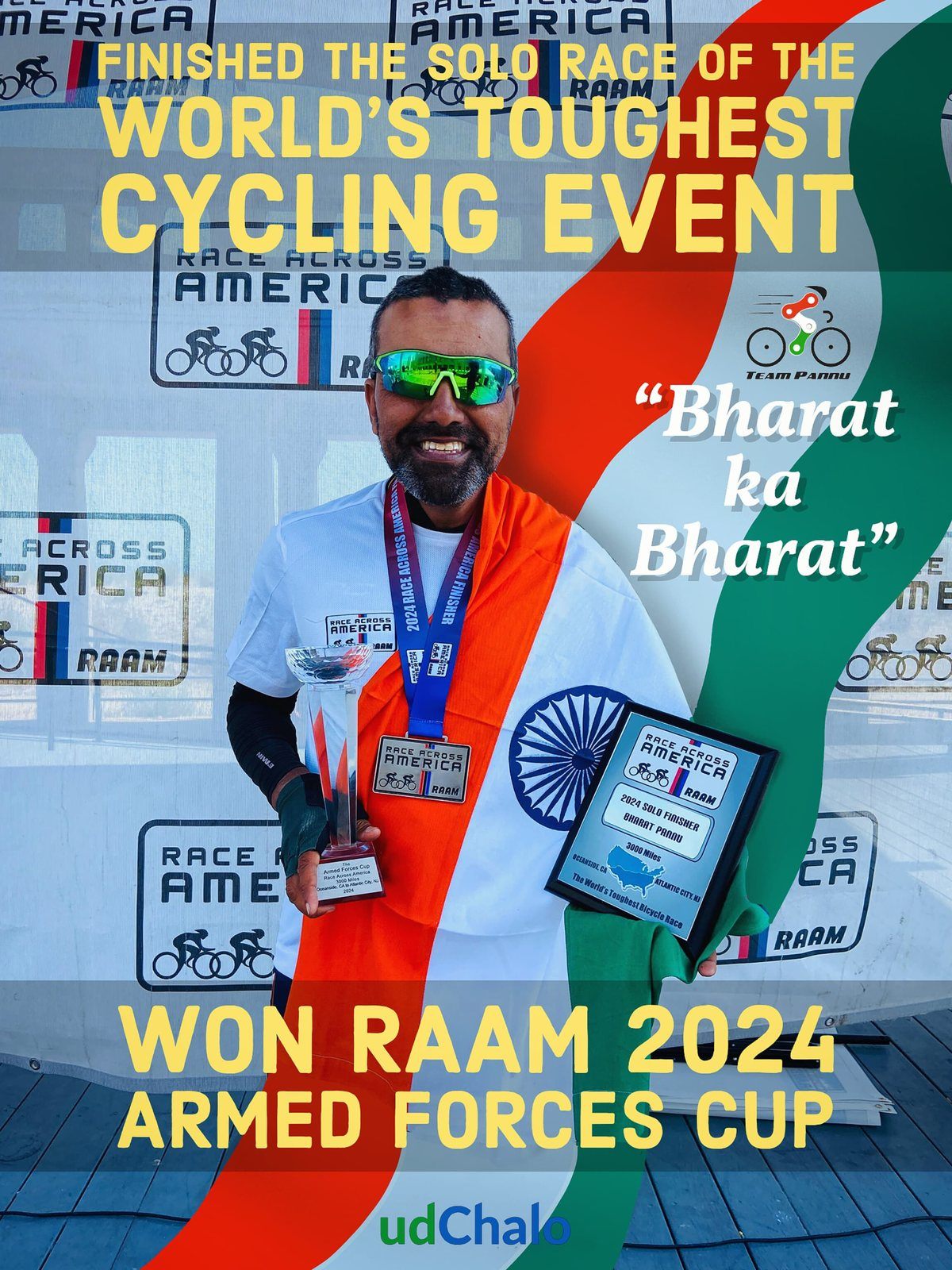
Third time lucky. After a 2019 injury and a 2022 illness, I completed the Race Across America solo — and won its Armed Forces Cup.
Race Across America had fascinated me for years, and my history with it is a study in perseverance: a crew role with Team Sea To See in 2018, a broken collar bone before the 2019 start, the virtual-RAAM podium in 2020, and a 2022 attempt ended by illness. In 2024 it was, finally, third time lucky.
Preparation. After my Ahmednagar posting ended in 2023 I was transferred to Suratgarh in the northern Thar desert — predominantly flat, blazing in summer and cold in winter. Those extremes made it an ideal place to train for an endurance race. I used the October 2023 Ultra Spice Race to hit my preparation targets, then committed to RAAM 2024 under the guidance of my coach, Tracy McKay, who herself completed RAAM in a two-person team in 2002 and was crew chief for Chris MacDonald's solo runner-up finish in 2005.
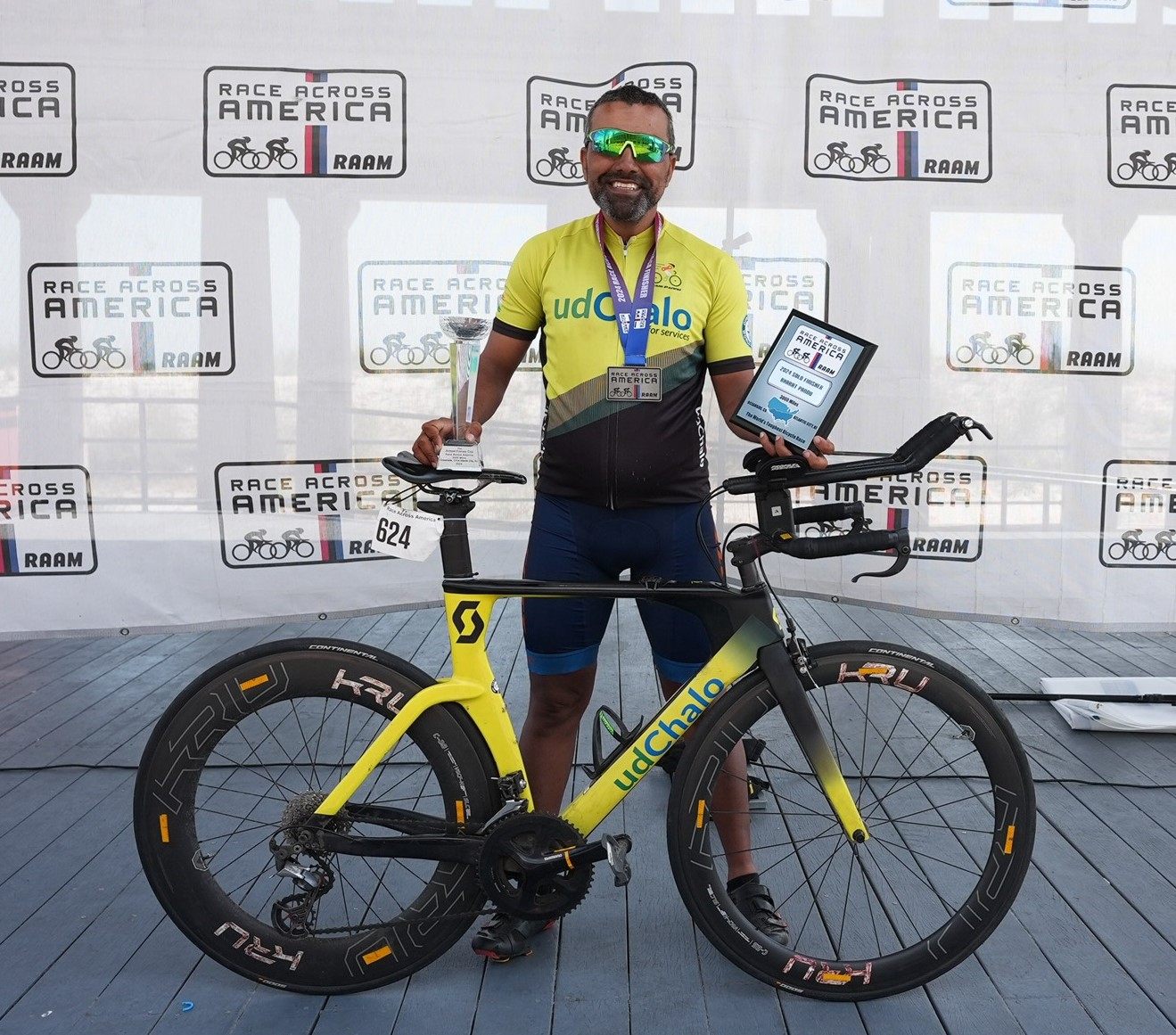
The race. I reached the US four days early, did two short trial rides totalling about 100 miles, and lined up with a nine-member crew — seven from India and two from the US — and three bikes: a Scott Foil road bike, a Scott Plasma time-trial bike and a Trek Emonda. The start went smoothly: we hit the halfway point in five days and nine hours. Then Kansas threw two days of brutal cross-winds at me, draining energy and slowing my average. Riding strongly early had tempted us to trade sleep for miles, and that debt came due — the tenth and eleventh days, especially the hours between midnight and 6 AM, were the hardest of my life on a bike.
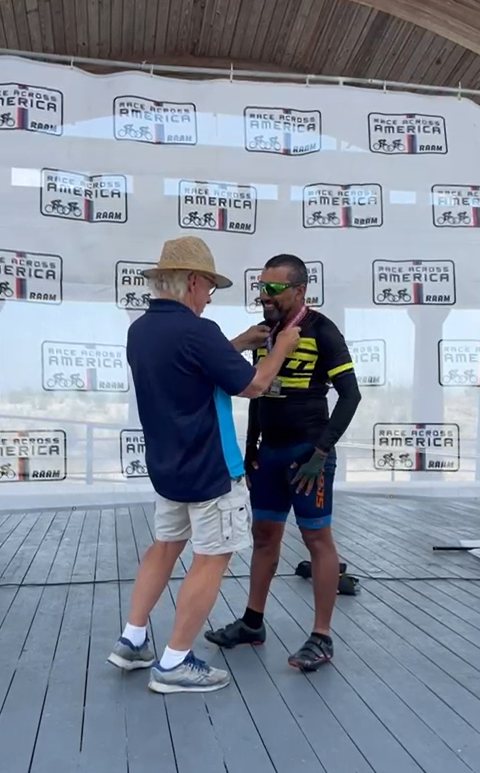
The finish. I reached the finish on the Atlantic seaboard inside the 12-day cut-off, covering the route in 11 days, 23 hours and 36 minutes — a figure that included a one-hour penalty for impeding traffic. Beyond simply finishing RAAM solo at the third attempt, I won the race's Armed Forces Cup. It took three attempts and more than five years; I feel content, and satisfied.
The Race Across America is one of the longest-running and most respected endurance events in world sport — a transcontinental time trial in which the clock never stops. Solo riders cover roughly 3,000 miles (close to 5,000 km) with around 175,000 feet of climbing, crossing twelve states, three great mountain ranges (the Sierra Nevada, the Rockies and the Appalachians), four of America’s longest rivers, the Great Plains, and the Mojave and Sonoran deserts, past landmarks like Monument Valley. There are no stages and no neutralised nights: every minute spent sleeping is a minute conceded. Solo finishers must complete the route inside the 12-day cut-off. The 2024 edition ran from Oceanside, California to the boardwalk at Atlantic City, New Jersey.
Within RAAM sits the Armed Forces Cup — awarded to the fastest racer among the participants drawn from the armed forces of various nations. Bringing that cup home to India was the stated objective of this campaign, seven years in the making.
Desert inferno at the start. The race opens with steep climbs and then drops into the deserts of California and Arizona, where daytime temperatures push past 45°C and the first battle is simply dehydration and heat stroke.
High-altitude hardship. The Rockies bring cold nights, thin air above 3,000 metres and relentless winds across the high plateaus — climbing on a body already drained by the desert.
Flatlands and the long middle. The Great Plains offer hundreds of featureless kilometres and strong crosswinds; the terrain stops being a physical problem and becomes a mental one.
Humidity and hills. The Midwest answers with high humidity, storms and endlessly undulating roads that drain energy a few metres at a time.
The final examination. The Appalachians arrive last — steep, narrow, repetitive climbs thrown at a rider with more than 4,000 km in the legs — before the descent to the Atlantic and the finish at Atlantic City.
Extreme heat. Ground temperatures in the desert stages exceed 50°C; the furnace causes cramping, dehydration and the constant threat of heat stroke.
Cold and altitude. Climbs like Wolf Creek Pass expose riders to freezing temperatures, sleet and low oxygen within a day of the desert.
Wind. Open roads in Kansas and Colorado turn flat terrain into mental warfare with harsh, unbroken crosswinds.
Sleep deprivation. On one to two hours of sleep a night, hallucinations and confusion are not a possibility but a certainty to be managed.
Physical breakdown. Saddle sores, nerve pain in the hands, and Shermer’s Neck — when the neck muscles simply stop holding the head up — are routine hazards of the second week.
Mental burnout. Long isolated stretches distort time and can trigger emotional collapse; the mind needs reinforcing as deliberately as the body needs feeding.
Traffic, navigation and machines. Complex turns at night, heavy traffic, and mechanical failures in remote country — any wrong turn or flat tyre costs time the clock never gives back.
Twelve days from the Pacific to the Atlantic, told in twelve frames — the heat, the night lows, the crew that held it together, and the finish at Atlantic City with the Armed Forces Cup.