

I want you to imagine not sleeping for two nights — and still being expected to perform at your peak. Now imagine doing that not for two nights, but for nine. On the ninth night of the Race Across America, I had slept barely sixteen hours since the race began. My legs were cramping, my vision was blurring, and I was hallucinating. And for the first time in my life, quitting didn't feel like failure. It felt logical.
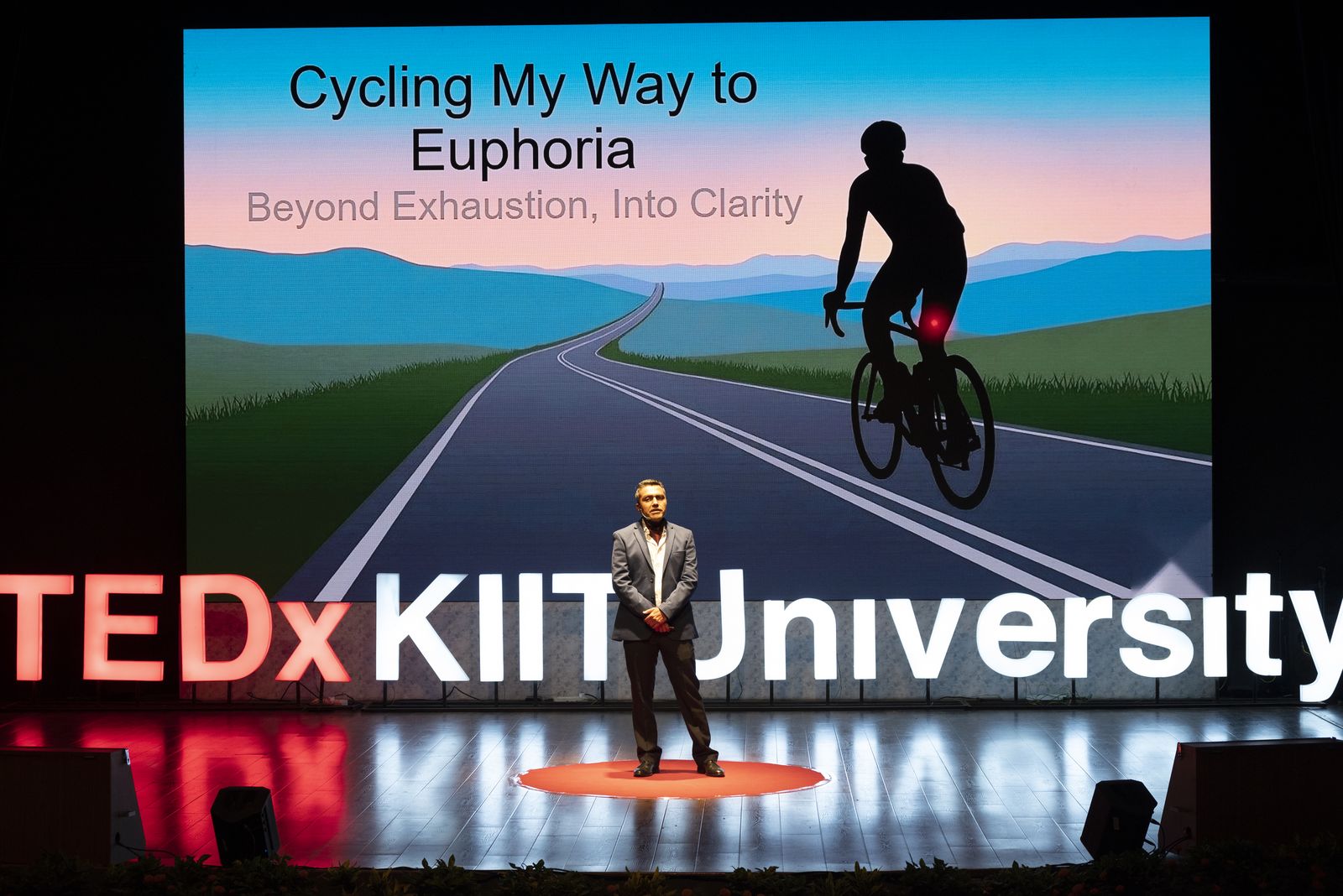
This is the story of why I didn't — told the way I told it on the TEDx stage at KIIT University.
The world's toughest time trial
RAAM is an ultra-distance race of nearly 5,000 km, from the Pacific coast of the USA to the Atlantic. Since the race began in 1982, only around 388 solo cyclists have finished it within the time limit. It is the world's toughest individual time trial: the clock starts once and stops only at the finish. Twelve days. 288 hours. Roughly 420-plus kilometres every single day, across four time zones, through the Mojave and Sonoran deserts, over the Sierra, the Rockies and the Appalachians, and across the endless plains — everything managed on the road, on the go, by a crew who work day and night so the rider can simply ride.
In my 2024 attempt I didn't sleep at all for a couple of nights, slept ninety minutes on a few, and three hours on the rest. But this is not a story about cycling. This is a story about what happens when you go beyond what you believe is your limit.
People often ask me what goes on in my mind while riding. The truth is that the real race is not on the road — it's in the mind. One voice keeps asking: Why are you doing this? Is it even worth it? How many more sunrises from the saddle? What if you just… stop? But there is another voice — quieter, yet stronger. It doesn't argue. It just refuses to quit. And somehow the body keeps moving, through pain, through doubt, through the unimaginable. At some point it stops being passion and becomes purpose.
1. Break the impossible
Five thousand kilometres is not just difficult — it's paralysing. There were moments when the remaining distance felt impossible. So I stopped asking, "Can I finish this race?" and started asking, "How far is the next time station?" Sometimes that was eighty kilometres. Sometimes just ten. The moment I reduced the problem, my fear reduced with it. And that is how impossible gets done: not 5,000 — just 25.
2. Adaptability beats planning
We had a perfect plan. Nutrition, hydration, navigation, sleep cycles, power targets, heart-rate zones — a backup for everything. By the first night, the heat was higher than expected, a tyre burst on the support vehicle, and my gear shifter malfunctioned. The plan lasted twelve hours; the race lasted twelve days. Out there, conditions change faster than your preparation, and I realised that success is not executing a plan perfectly — it is adjusting, again and again, without losing direction. Your plan will fail. Your timeline will shift. The real question is whether you adapt well and keep going.
3. Consistency beats intensity
There were riders stronger than me, faster than me. Early in the race I watched them overtake me, and honestly, it was daunting. But by day four, day five, some of them started disappearing — injuries, burnout, poor pacing. And I was still there. Not because I was exceptional, but because I was consistent. Consistency is the ability to continue even when motivation is gone. In ultra-endurance you don't run out of time first; you run out of energy — and when energy is gone, time becomes irrelevant.
4. Fatigue is mental first
Day six. My legs were fine. My nutrition was on point. But my mind was done. I was riding through an empty stretch — no climbs, no extreme weather, no obstacles. Nothing had changed outside, but inside, everything was falling apart. That's when it hit me: fatigue isn't physical first. It's a negotiation in your mind. The mind whispers options — slow down, take a break, it's not your day — and if you listen long enough, you start believing it. The truth is that the mind gives up before the body does.
5. The support system defines success
On the tenth night I was hallucinating. I saw things on the road that weren't there; at one point I truly believed someone was running beside me. In that moment I could not trust my own mind — and that's when my team took over. They controlled my stops. They made me eat. They decided when I rode. They took complete control. And I realised something powerful: strength is not always pushing harder. Sometimes strength is letting go, and trusting someone else to hold you together. Success is never individual. It is built on people who refuse to let you quit — and mine, led by Lt Col Sandeep Kumar, never did.
Your RAAM may not be a race
You don't have to ride RAAM to feel what I felt. Your RAAM could be your career, your relationships, or a battle no one else can see. During training I kept comparing myself to stronger riders and believed I was behind — until I understood I was comparing their middle to my beginning. I came to competitive cycling late, with no sporting background — not in school, not in college. The only cycling I knew was riding to school and back. When you understand where someone's journey began, comparison becomes meaningless. Don't judge anyone's pace; you don't know their battles.
Beyond exhaustion, into clarity
The discomfort and pain were always there. But somewhere in that second week I stopped fighting them. I stopped asking, "How do I get out of this?" and started asking, "How do I move with this?" The pain didn't disappear — it just stopped mattering. There was clarity. There was calm. There was euphoria. Not because the race got easier, but because, somehow, I had become stronger than the struggle.
I started cycling long distances to discover my limits. Somewhere along the way I discovered something far more powerful — joy in the planning, in the execution, in the challenges themselves. Euphoria isn't waiting at the finish line. It lives within the struggle. And like every good Bollywood story, the ending matters: no matter how tough the journey, it's the smile at the end that makes it worth it.
- Shrink the number: not 5,000 — just 25, then 25 again.
- Hold the direction, not the plan: adapt without losing your bearing.
- Stay steady: consistency outlasts intensity every time.
- Catch the negotiation early: the mind gives up before the body does.
- Build people who refuse to let you quit — then trust them enough to let go.
This post is my TEDx talk, "Cycling My Way to Euphoria — Beyond Exhaustion, Into Clarity" (TEDx KIIT University), in written form.